
Ask a room of tech job seekers what's broken and you'll hear about the silence. Applications that vanish. Four interview rounds and then nothing, not even a rejection.
I hear it too. But the thing that hurts most isn't the thing eating most of their time, and the data is fairly clear about which is which. What hurts is the silence. What costs is the noise. And the noise is what produces the silence.
Disclosure up front: I build Match Moth, a job search tool aimed at exactly these problems. The last section covers how. Everything before it stands without it.
The biggest problem is noise
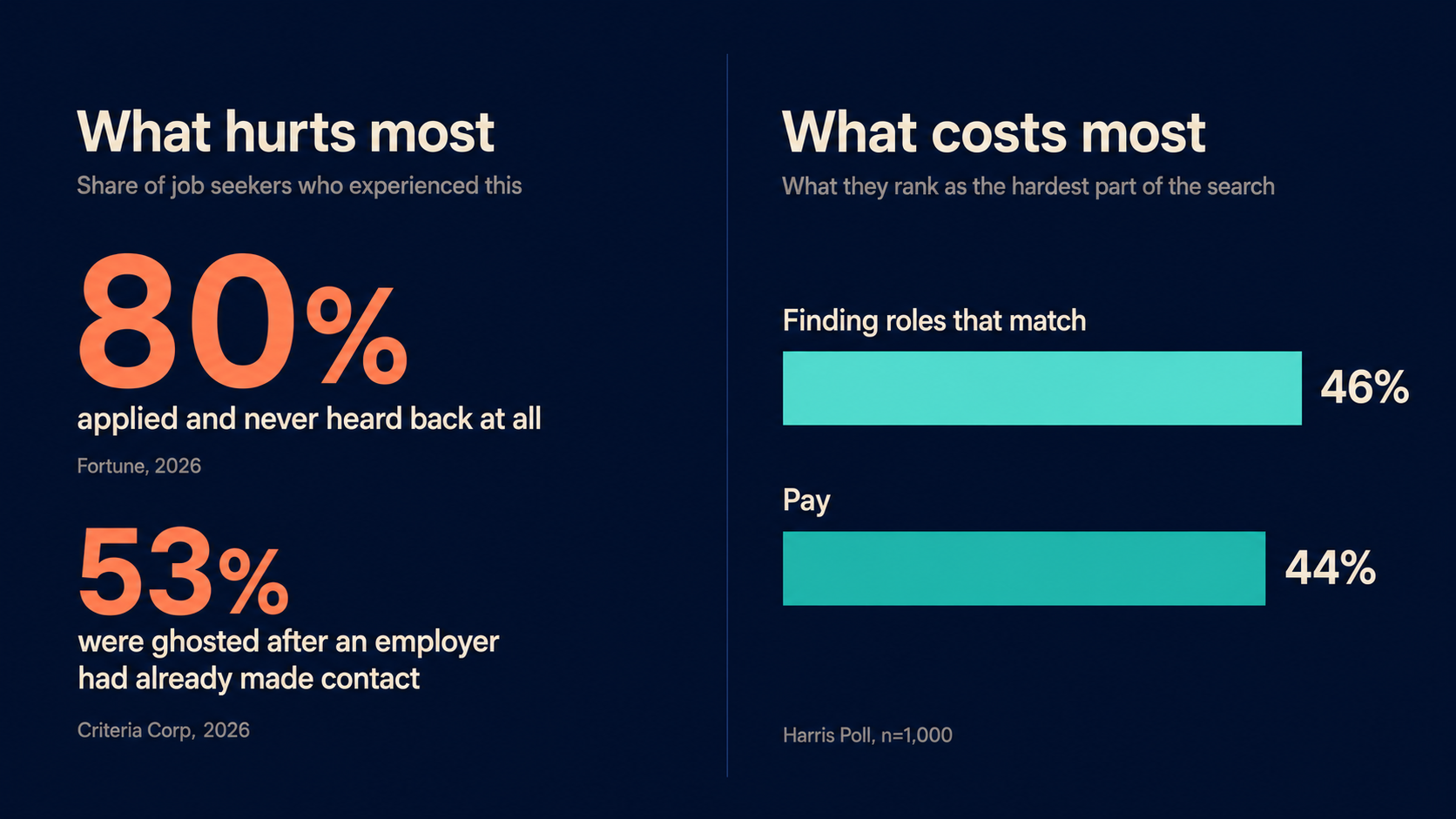
When the Harris Poll surveyed 1,000 US job seekers in mid-2026, the top-cited pressure wasn't pay or interviews. It was "finding opportunities that match my qualifications," at 46%, just ahead of pay at 44%.
Which tracks, if you look at where the hours actually go. The right roles exist. Finding yours in the flood is the work, and keyword search isn't up to it. Search "product designer" and you'll get a senior product role and a print-design contract in the same list, so the job of reading every description lands on the person with the least time to do it. Nobody writes an angry post about that. It's ambient, the water you're swimming in. It still eats most of the week.
Most of a job search isn't applying or interviewing. It's triage.
Two things make the flood worse than it looks.
A chunk of it isn't real. Independent estimates put ghost jobs at roughly 1 in 5 online postings, and that isn't paranoia from the seeker side. When Clarify Capital surveyed 1,000 hiring professionals, 93% admitted posting jobs they weren't actively trying to fill, at least occasionally. The Congressional Research Service has written it up as a market problem. Every fake listing costs somebody a description read, a resume tailored, an application sent into nothing.
AI auto-apply tools keep pouring volume in on top of that. LinkedIn now processes over 11,000 applications per minute, per LinkedIn's own data as reported by The New York Times, and Statista's 2026 figure puts it closer to 14,200. Auto-apply tools spray generic applications, recruiters answer with AI screening, and genuine fit gets lost in both directions. I'm not arguing against AI here. I'm arguing against pointing it at volume.
The part I didn't expect: the flood is drowning the employer side too. The Pragmatic Engineer interviewed more than 50 hiring managers and engineering leaders in mid-2026 and got a consistent picture back. Recruiters have largely given up on inbound applications, because the inbox is full of AI-generated slop, some of it from candidates who don't exist. Experienced engineers report getting interviews only when they personally know somebody inside. Seekers spray because nobody answers. Nobody answers because of the spray. Each side's defense makes the other side's problem worse.
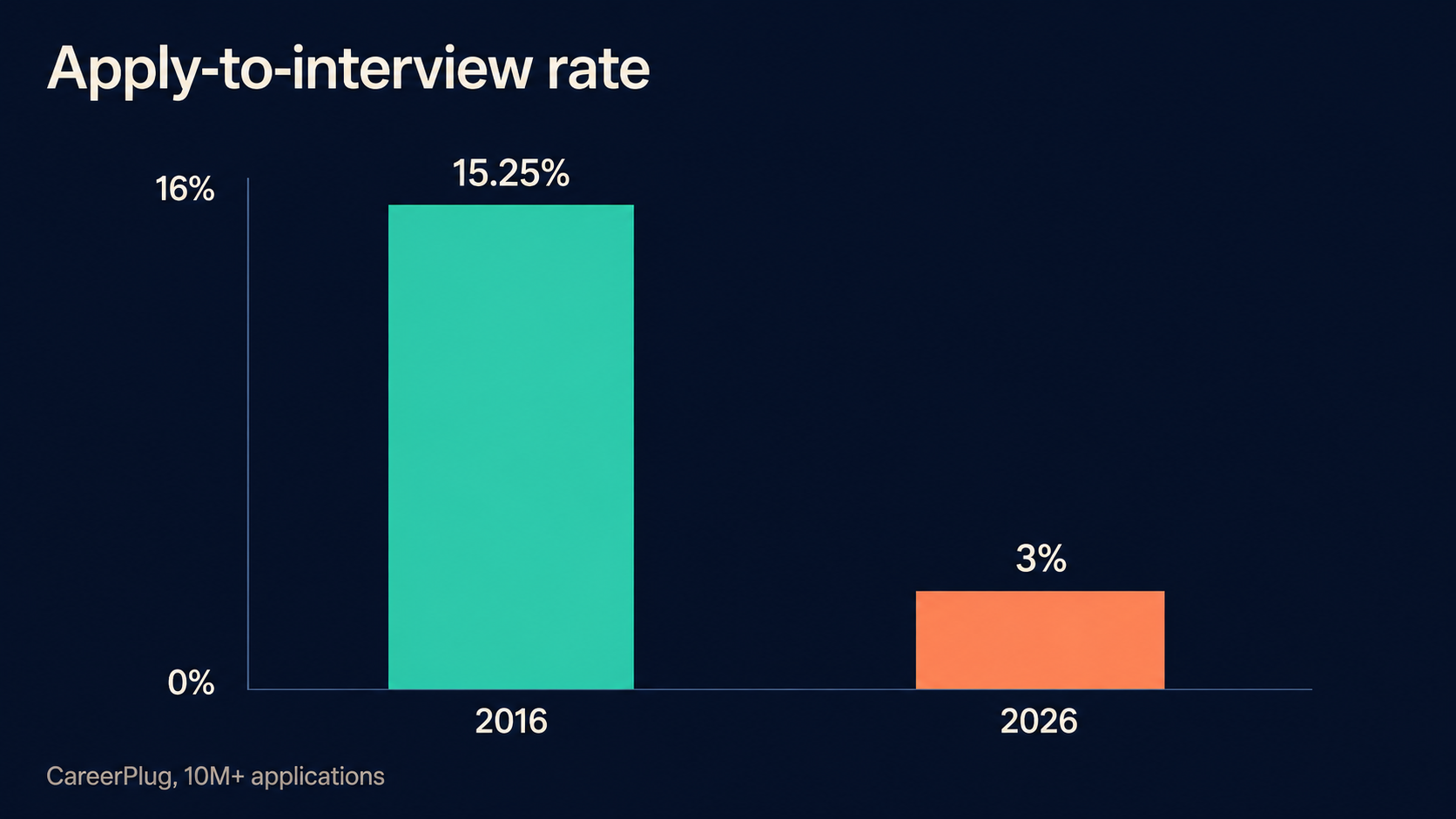
CareerPlug's data across 10 million applications has apply-to-interview rates falling from 15.25% in 2016 to 3% today. Five times worse in under a decade, with volume as the mechanism. To be clear, that's on the tools, not on the people using them. When your odds feel hopeless, sending more applications is the one lever that still feels like yours. It just makes the pile taller for everybody, yours included.
The loudest problem is silence
Employer ghosting hit a three-year high in 2026. Criteria Corp's candidate experience research found 53% of seekers were ghosted by an employer in the past year, up from 38% two years earlier. It's the thing you'll hear about most, and the most corrosive, because every instance is a specific thing you remember. Noise costs you a Tuesday. Silence follows you around.
Here's how the two connect, which is the whole point of this post. At a 3% apply-to-interview rate, 97 of every 100 applications were headed for the void before you sent them. Most of that waste got decided upstream, on roles that were dead, fake, or never a real fit. You experience the silence at your inbox. It was caused back at the filtering stage.
The silence is the receipt for the noise.
Nobody on the seeker side can make employers write back, and I won't pretend a tool changes that. What you can control is how many of your applications go somewhere no reply was ever coming from.
What I'm doing about it
I spent months inside this exact grind as a senior product designer and got annoyed enough to build the thing I wanted. That's Match Moth.
It works upstream. It reads your resume once, then watches about 24 job sources daily, mostly company career sites, which CareerPlug's data has converting at roughly 3x the rate of job boards. Dead and ghost listings get probed nightly and dropped. Every role that survives is scored against your actual resume with the reasoning shown, and when a posting doesn't say enough to judge an axis, the score says so instead of guessing. You get a ranked feed and one email a day. Not fifty alerts.
What it will never do is auto-apply. It points AI at filtering instead of flooding, so you send fewer applications, better aimed, into the channel where the odds are actually better.
Fewer, better-aimed applications. Never more of them.
Match Moth is in open beta now at matchmoth.com. If you're searching in design, product, engineering, or a handful of other tech families, I'd like to know whether the scores hold up against your own read of the same postings.
That's the product. Everything above it is why it exists.
Sources
- 46% "finding opportunities that match my qualifications" (and 44% pay): Express Employment Professionals Job Seeker Report, conducted by The Harris Poll, May 19 to June 8, 2026, among 1,000 US job seekers.
- 11,000+ LinkedIn applications per minute: LinkedIn platform data, reported by The New York Times (June 2025). The ~14,200/minute 2026 figure: Statista.
- 3% apply-to-interview rate, down from 15.25% in 2016; careers pages converting ~3x job boards: CareerPlug Recruiting Metrics Report, 10M+ applications across 60,000+ businesses. Note: CareerPlug's client base skews small-business, so treat these as economy-wide benchmarks rather than tech-specific.
- Ghost jobs at roughly 1 in 5 postings; 93% of hiring professionals admit posting them: Congressional Research Service and Clarify Capital, Ghost Jobs 2.0 (survey of 1,000 hiring professionals).
- Recruiters overwhelmed by AI-generated applications; interviews increasingly requiring an inside connection: The Pragmatic Engineer, Tech Jobs Market in 2026, Part 3, based on interviews with 50+ hiring managers, software engineers, and engineering leaders.
- 53% ghosted by an employer in the past year, a three-year high: Criteria Corp 2026 Candidate Experience Report, via Fortune.