
A moth doesn't circle your porch light because it's fooled into navigating by it. For a few hundred million years, the brightest thing in a moth's world was the sky, so keeping the light above was a reliable way to know which way was up. Then we hung a bright bulb twenty feet from every back door, and the same instinct that always worked started flying moths in circles until they dropped. The moth isn't lost; its sense of up is.
I've spent this year building a job search tool, and the porch light is the most accurate description I've found for what the modern search does to a capable person's attention.
Job boards are the bulb. They're bright, close, and engineered to hold you: every open role in one search box, reposted to look fresh when it's stale, surfaced because an employer paid for placement rather than because it fits you. The numbers say the holding works far better than the finding. LinkedIn processes over 11,000 applications a minute, up about 45% in a single year, per LinkedIn's own platform data as first reported by The New York Times. An average posting draws 180 to 250 applicants. Between 2 and 3 percent of applications ever become an interview. Everyone can see the light. Almost nobody gets anywhere by flying at it.
The loudest problem and the biggest one
Ask job seekers what they complain about most and the answer is silence. Per Fortune's reporting, 80% have applied to a job and heard nothing back, and a majority call it the worst part of the search. I believe them. Silence is event-shaped: each one is a specific role you wanted, a specific evening you spent tailoring, and a specific nothing that came back.
Ask a different question and you get a different answer. When The Harris Poll surveyed 1,000 U.S. adults for Express Employment Professionals' 2026 Job Seeker Report and had them rank what actually makes the search hard, 46% put "finding opportunities that match my qualifications" first. It beat pay, and it beat interviews, which surprised me the first time I read it, because nobody vents about their search bar the way they vent about being ghosted.
Here's how the two answers fit together: silence is the receipt for noise. At a 2 to 3 percent interview rate, about 97 of every 100 applications were spent on the void, and most of that waste was decided before the apply click, back at the filtering stage, on roles that were dead, fake, or never a real fit. The average seeker spends about six hours a week searching, per Howdy's survey of job hunters, and the bulk of that time is triage: open the tab, read the description, close the tab. Nobody on the seeker's side can make employers reply. I want to be straight about that, because plenty of tools imply otherwise. What a tool can do is move your effort upstream of the silence, so fewer of your applications were doomed the moment you sent them.
Where you apply matters as much as how often. CareerPlug's Recruiting Metrics Report, drawn from over 10 million applications across 60,000 businesses, found job boards producing 61% of applications but only 42% of hires. Company careers pages produce 13% of applications and 26% of hires. Run the division and an application through a company's own careers page carries roughly three times the odds of one fired into a board. The crowd is pointed at the door that converts worst.
Then there's the inventory itself. Resume Genius found 67% of seekers have suspected a listing was fake. Clarify Capital surveyed 1,000 hiring professionals and 93% admitted their company had posted a ghost job, a listing with no intent to hire for that role right now, and current estimates put ghost jobs at roughly one in five postings. Some of the light isn't even a real bulb.
What I built
Match Moth reads company job boards directly: Greenhouse, Lever, Ashby, Workday, and the rest of the ATS platforms that sit behind most careers pages. It watches about 24 sources a day and collapses duplicates into one real role, so the same posting doesn't reach you five times wearing five different aggregator logos. No employer pays for placement in the feed, so there's no incentive to inflate it.
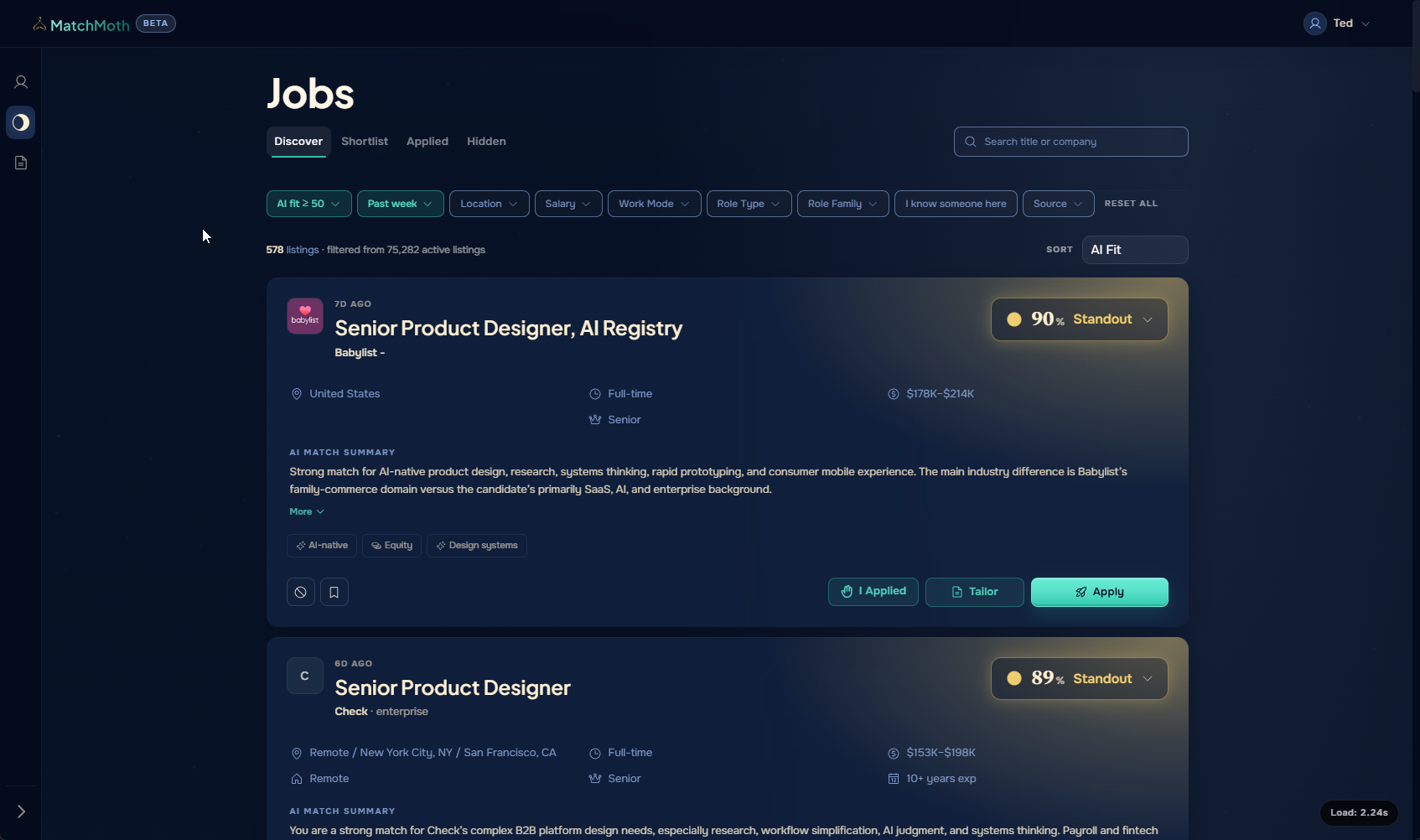
Freshness is checked, not assumed. Listings are probed nightly and dead links get hidden automatically. Postings past 30 and 60 days are demoted rather than quietly deleted, with the arithmetic shown, because staleness is information you deserve to see rather than a trick to keep the feed looking full. A role that quietly died two weeks ago drops out of your feed before it can eat your evening.
Every listing that survives is scored 0 to 100 against your actual resume, across five axes: skills, seniority, industry, pay, and location. Each axis quotes its evidence from the posting and from your resume, so you can check the reasoning, and argue with it, instead of trusting a percentage. You get a one-line verdict, the requirements you already show evidence for, and the gaps you don't. And when a posting doesn't say enough to judge an axis, the score says "couldn't evaluate." It doesn't guess. That choice costs me something real: an honest gap looks worse on a screen than a confident number, and a competitor's inflated percentage will always demo better than my "couldn't evaluate." I take the trade anyway. A filter you don't trust is a filter you re-check behind, and re-checking is exactly where those six hours a week were going.
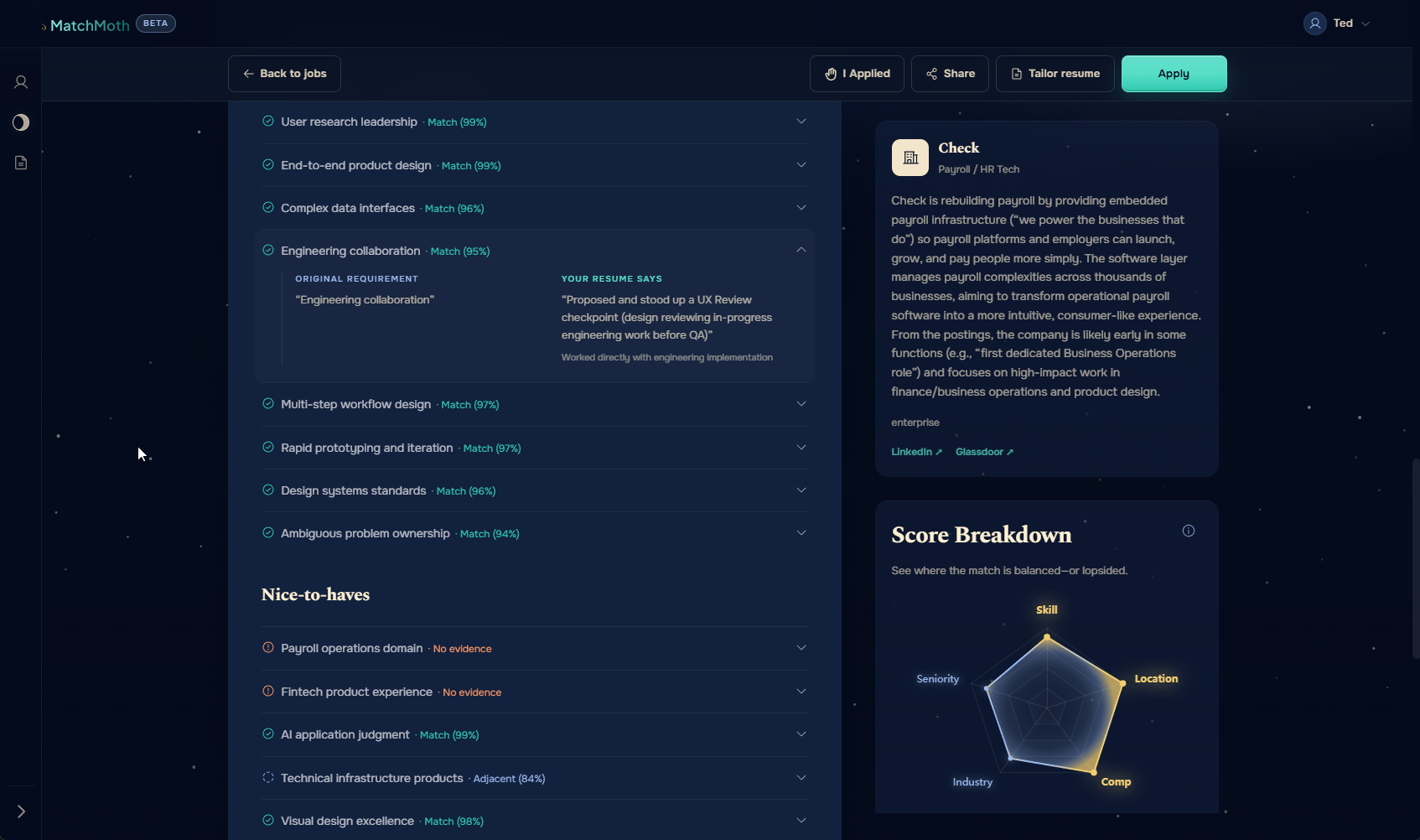
Then it stays out of your way. One digest a day, hard-capped at five new matches plus up to three reminders of strong roles you haven't acted on, and each reminder appears three times at most, ever. If nothing cleared your bar, the digest says so and stays short. I'd rather send "nothing new today" than pad the email with filler listings to look busy. Inside the app, your pipeline (Discover, Shortlist, Applied, Hidden) lives in the feed itself rather than in a separate tracker, and when you update your resume or preferences, everything re-scores.
When a role is worth an application, you can tailor your resume to that specific job and review every proposed change as a before/after you accept or reject one at a time. Employers, titles, dates, and every number are locked to your source resume in code; the model can rephrase and re-frame, it cannot invent. If the tailored version doesn't beat your original's score for that job, you never see it and you aren't charged for it. Sometimes the honest answer is that your resume already wins.
What I'm not building
Auto-apply. Plenty of tools will fire a hundred applications for you overnight, and the research keeps saying volume is the wrong lever: fewer, targeted, tailored applications outperform spray-and-pray, and recruiters report spotting templated output easily. The arms race runs both directions too. Mass-apply tools raise the pile, employers answer with AI screening of their own, and signal gets lost on both sides. Whether to apply is the one judgment call in this entire process that's actually yours, and it's the one place a tool should never substitute its judgment for yours. Match Moth narrows the field and shows its work. The clicking stays with you.
The beta
The open beta started August 21, capped at 150 seats. The cap is deliberate. Nightly probing, deduplication across two dozen sources, and evidence-backed scoring aren't free to run well, and at this size I can still talk with every person using the product. Every page has a contact path that works without signing in, because a broken sign-in is exactly when you need support.
It's free during the beta, and the price after it is already settled: $20 a month. Founding members who finish onboarding get their first month free and 20% off that price for life, and helping with score ratings and two short surveys takes the lifetime discount to 40%. I'm publishing the terms now because "free during beta" tools have burned people before, and the only real answer to that suspicion is the actual number, in writing, before you sign up.
If you're mid-search and tired of re-checking the same ten careers pages, claim a seat at matchmoth.com. If the cap's hit, the waitlist is real and I admit people in order.
The moth never needed a brighter porch light. It needed the one it was built for. Steer by the true light.
Sources: Express Employment Professionals / The Harris Poll, 2026 Job Seeker Report (n=1,000 U.S. adults): the 46% top-challenge figure. CareerPlug Recruiting Metrics Report (10M+ applications, 60,000+ businesses): source-of-hire shares and apply-to-interview rates. LinkedIn's own platform data, tracked by Statista: 11,000+ applications/minute as of the reporting cited here, up ~45% year over year (since risen to ~14,200/minute). Fortune: 80% no-response, majority calling silence the worst part. Clarify Capital (1,000 hiring professionals surveyed): 93% admit posting ghost jobs; Congressional Research Service: the ~1 in 5 ghost-listing estimate. Resume Genius 2026: 67% suspected a fake posting. Howdy: ~6 hours/week search time.