
Why visual polish alone no longer wins design jobs
Picture two case studies for the same checkout redesign. Both have clean Figma frames, a tidy type scale and a before-and-after. The first walks through the double diamond: research, synthesis, ideation, testing.
The second opens with one sentence: "We dropped guest checkout for returning users and accepted fewer first-week sales, because lost-order support tickets were costing us more."
Which designer do you think most hiring managers would rather talk to about the design job? The answer is the second designer, according to my research on what hiring managers look for in product design and UX jobs.
It turns out you learn a lot about the latest ins and outs of tech careers when you're building an AI job matching tool like Match Moth. Research is key, so in order to help potential Match Moth users, I read what a dozen hiring managers, design leaders, and people who screen design portfolios for a living have published over the past year, plus a few older posts for comparison.
My goal was to learn what hiring managers actually look for when they fill UX jobs and other design jobs. The results were interesting. Visual polish barely came up as the ultimate deciding factor. But judgment came up constantly: can this person make a good call, explain why, and own it when it goes sideways?
If you're in a tech job search for design roles right now, this information should change where your effort goes. Here's what else to consider as you decide where to apply with the help of AI career tools like Match Moth.
What do hiring managers look for in UX and product design jobs?
Hiring managers for UX and product design jobs mostly look for judgment: evidence that you can make a good design decision, explain the tradeoff, and own the result. In 2026, visual polish is treated as the baseline, because AI tools make good-looking mockups cheap. Across what a dozen design hiring managers and portfolio reviewers have published, the strongest signals are:
- Judgment wins. Hiring managers want to find the decision you made, the tradeoff, and why.
- Polish is the baseline. AI tools made good-looking mockups cheap, so they prove less.
- Process write-ups impress less. Shown work beats a walk through the double diamond.
- Interviews test judgment live, often with AI tools in the room.
- Show what went wrong, say "I" for your calls, and tie results to your reasoning.
What design hiring managers look for in a portfolio
The portfolio still carries most of the weight. In UXfolio's 2026 survey of more than 100 design hiring decision-makers, 78% said the portfolio is their main way of judging role fit at first look.
Make each design decision easy to find
Emily Backes, a senior product designer who spent years as a technical recruiter, puts it plainly: "A reviewer can't credit you for a decision they can't find." Michael Yap, head of product design at Acorns, asks candidates to "show how your design work informed key decisions, not just how it looked on a screen."
Show the tradeoffs and what went wrong
Backes again: "a portfolio with zero visible friction anywhere reads as edited." Tom Scott, who advises companies on design hiring and writes Verified Insider, says candidates who name what they'd do differently come across as more credible. Aneta Kmiecik, a design hiring partner, advises showing only real, shipped work.
Say "I" for the calls you made
Scott lists hiding behind "we" as one of the most common interview mistakes. Backes says vague team language hides who made which call. Hiring managers know design is collaborative. They still need to know which calls were yours.
Tie your results to your reasoning
Harry Enaholo, after reviewing more than 150 portfolios for a design lead role, said he checked whether the products were live, traceable, and scaling. Backes says a named number with the decision behind it earns a second read. When you don't have metrics, Scott's advice is to say so and describe what you would have measured.
Weak vs. strong: what a judgment example looks like
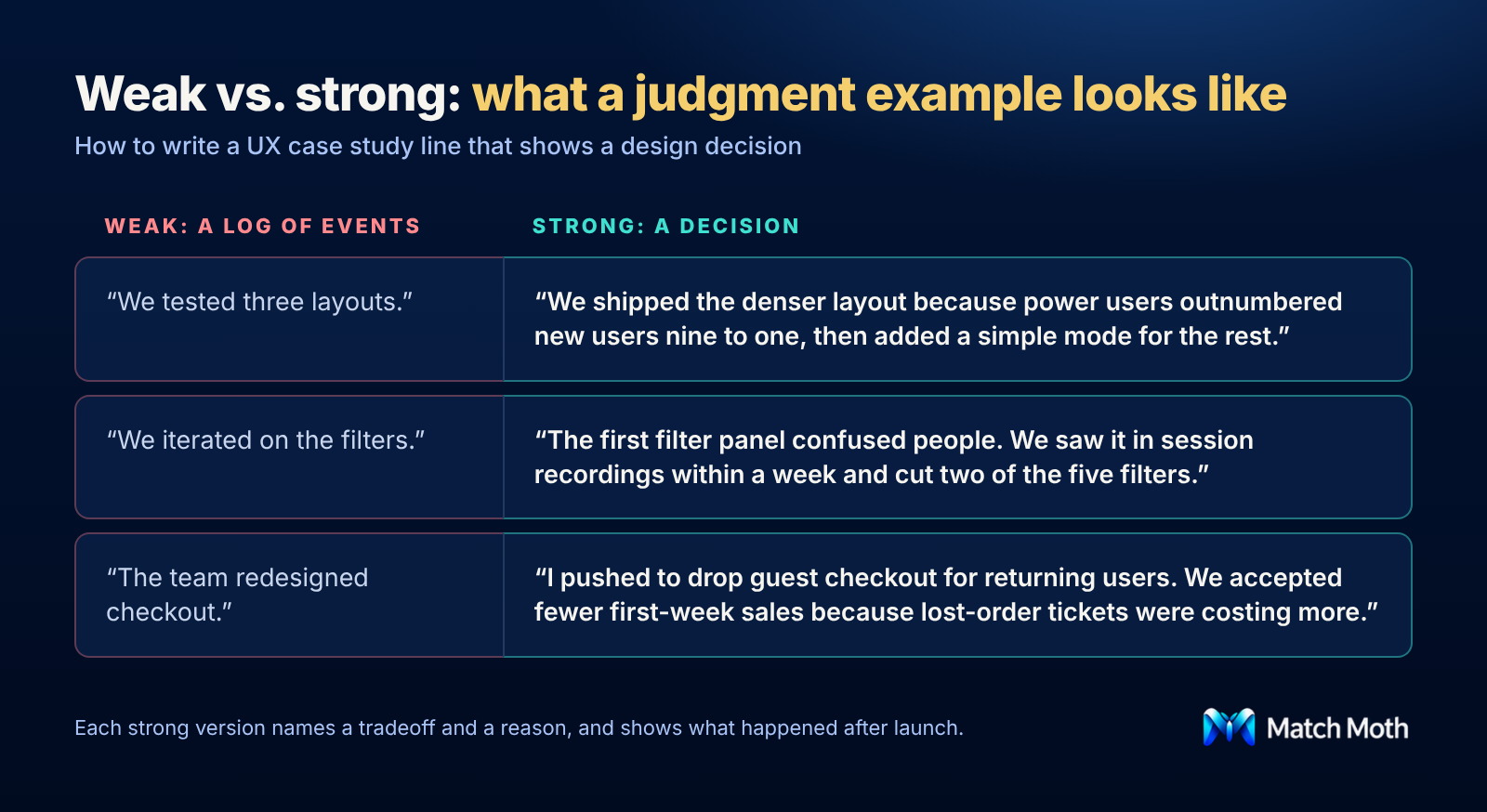
How design hiring changed in 2026
Judgment isn't a new requirement. Budi Tanrim wrote in 2021 that a portfolio of screens is weak because it can't show "whether a designer can make a good decision." A [2019 InVision piece] on design hiring already put business orientation and self-awareness ahead of hard skills. What's new is how much else has stopped counting.
Visual polish counts for less
Kasey Klimes, a design researcher and technologist, says execution is now so universally impressive that "it recedes into the background." Balint Bogdan calls a clean portfolio "the baseline, not the differentiator."
When AI tools can produce a good-looking mockup in minutes, a good-looking mockup proves less. Kmiecik adds that heavy AI use is making portfolios look alike, "based on average data."
Process walkthroughs impress less
Scott describes 2018 to 2023 as the "process process process" era. Now, he says, people "want to see work, not be told about it," and nobody wants "reams of text and the double diamond."
More interviews test judgment live
A designer quoted by Jeff Humble of the Fountain Institute described a first round that skipped the portfolio walkthrough entirely: open Figma, here's a problem, 25 minutes.
Scott describes interviews where candidates prototype with AI and talk through their reasoning as they go. Sebastian Speier lists "designing at the speed of conversation" alongside product sensibility and craft.
AI fluency is expected
Scott says portfolios with no sign of AI in the workflow read as a designer who hasn't adapted.
Roger Wong, who leads a design team at BuildOps, argues that as building gets cheap, the scarce skill is taste and judgment about what's worth building at all. That applies to AI output too, since someone has to decide what to keep.
Job search tips for your design portfolio
Put together, these make for a sharper job application strategy: fewer, targeted job applications, each one leading with a decision a hiring manager can find.
- Lead each case study with the decision, then the constraint, then the result. Put the process underneath for anyone who wants it.
- Add one sentence per project on what you'd do differently. Hiring managers read it as maturity.
- Write "I" wherever the call was yours, and say so plainly when it wasn't.
- Show one messy artifact, like a rejected direction, an early sketch or a raw Figma file. Scott says unfinished work can persuade more than a polished case study.
- If AI is part of your process, show where you overruled it. That's where your judgment shows.
- Practice explaining one decision out loud in two minutes, since live challenges reward people who can think in front of others.
FAQ: UX and product design hiring in 2026
Do hiring managers still care about visual design in UX portfolios?
Yes, but as a baseline. Clean visuals are expected, so they rarely decide who gets an interview. Balint Bogdan describes a clean portfolio as "the baseline, not the differentiator."
How do you show judgment in a UX case study?
Lead with the decision you made, name the tradeoff, and give the result. "We shipped the denser layout because power users outnumbered new users nine to one" shows judgment. "We tested three layouts" only describes activity.
How has UX and product design hiring changed in 2026?
Hiring managers now put less weight on visual polish and on process frameworks like the double diamond. More interviews include live design challenges, often with AI tools, and AI fluency is now expected.
Do UX portfolios need to show AI skills?
Increasingly, yes. Design hiring adviser Tom Scott says portfolios with no sign of AI in the workflow read as a designer who hasn't adapted. The strongest examples show where you overruled the AI.
What portfolio format do design hiring managers prefer?
A portfolio website. In UXfolio's 2026 survey of more than 100 design hiring decision-makers, 72% preferred a portfolio website over Figma prototypes, PDFs or slides, and 78% said the portfolio is their main way of judging role fit.
Finding the right design jobs with AI job matching
Hiring managers want to see the reasoning behind a call, and I've tried to hold Match Moth's AI job search to the same standard. It uses resume-based job matching: it scores each job against your resume and shows the line from your resume behind each score, so every match is explainable. When a posting doesn't say enough to judge, it says "couldn't evaluate" rather than guessing. That way you spend your evenings tailoring case studies for relevant jobs you actually fit, with less time lost to job search noise. It's free during the beta, at matchmoth.com.
So keep the screens, and put the call you made, and why, where a hiring manager will find it first.